He played a Labor Day pool party on music he had never heard, with mixes he had never practised. It was a blowout.
Not because he got better at open format that afternoon. Because the preparation had already been done, by something that had spent months learning how he plays.
“Not only did I not know any of the tracks I was playing — I didn’t practice any of the mixes. It was all brand new music. The thing is, I used DJ Brain, and it helped me organize it so well, and it understood how I like to play so well, and how the day needed to go so well, that I didn’t have to worry whatsoever.”
“It analyzed my past sets — the ones that I liked, the ones that I don’t — how I like to do my progressions, transitions, something for everybody. I literally played like a great open format DJ. And I’m not an open format DJ at all.”
- 01The stakes were real
A Labor Day pool party, a big one. Not a rehearsal, not a practice room — a floor, in daylight, with his name on it.
- 02Every safety net was gone
Almost every record was new to him. He had not practised a single one of the mixes. The usual preparation simply had not happened.
- 03He played outside his own discipline
He is a genre specialist — deep and narrow, precision inside one sound. That night he played open format, which is a wider library and harder edits, not an easier one.
- 04And the mechanism is specific
It had already read his past sets — the ones that worked and the ones that did not — his progressions, his transitions, and his instinct for giving a mixed room something for everybody.
The specifics are the point. A tool that only knows genres could not have done this.
Each of these is a thing DJ Brain records and uses, today — not a roadmap.
- Proven and flopped
Every record carries what actually happened to it in front of a crowd. Most tools only collect the wins. Silence is not a verdict.
- All-new material
A dial from the proven core to a set of records he had never played. That night sat at the top of it.
- The shape of the day
A pool party is an arc, not a playlist. Where the peak lands, and what has to happen before it can.
- His transitions, not a default
Phrasing, keys, which move to make at a seam and when to spend a transition track instead.
It knows your library. That is the whole difference.
Every generic DJ tool assumes an infinite catalogue. Yours is finite, uneven, and half-streamed — and that is what decides whether a set works.
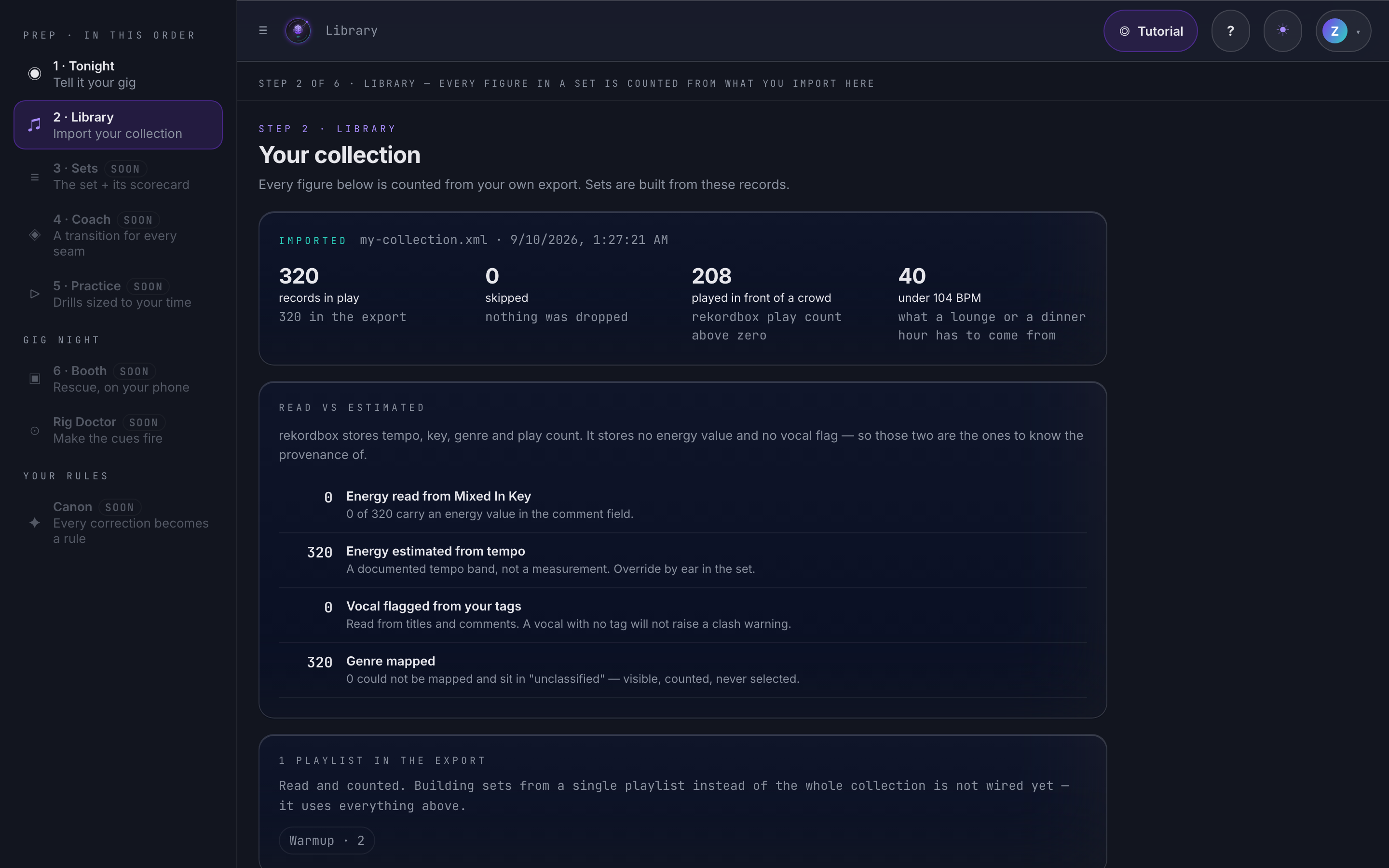
Library X-ray
The Booth. On your phone, offline.
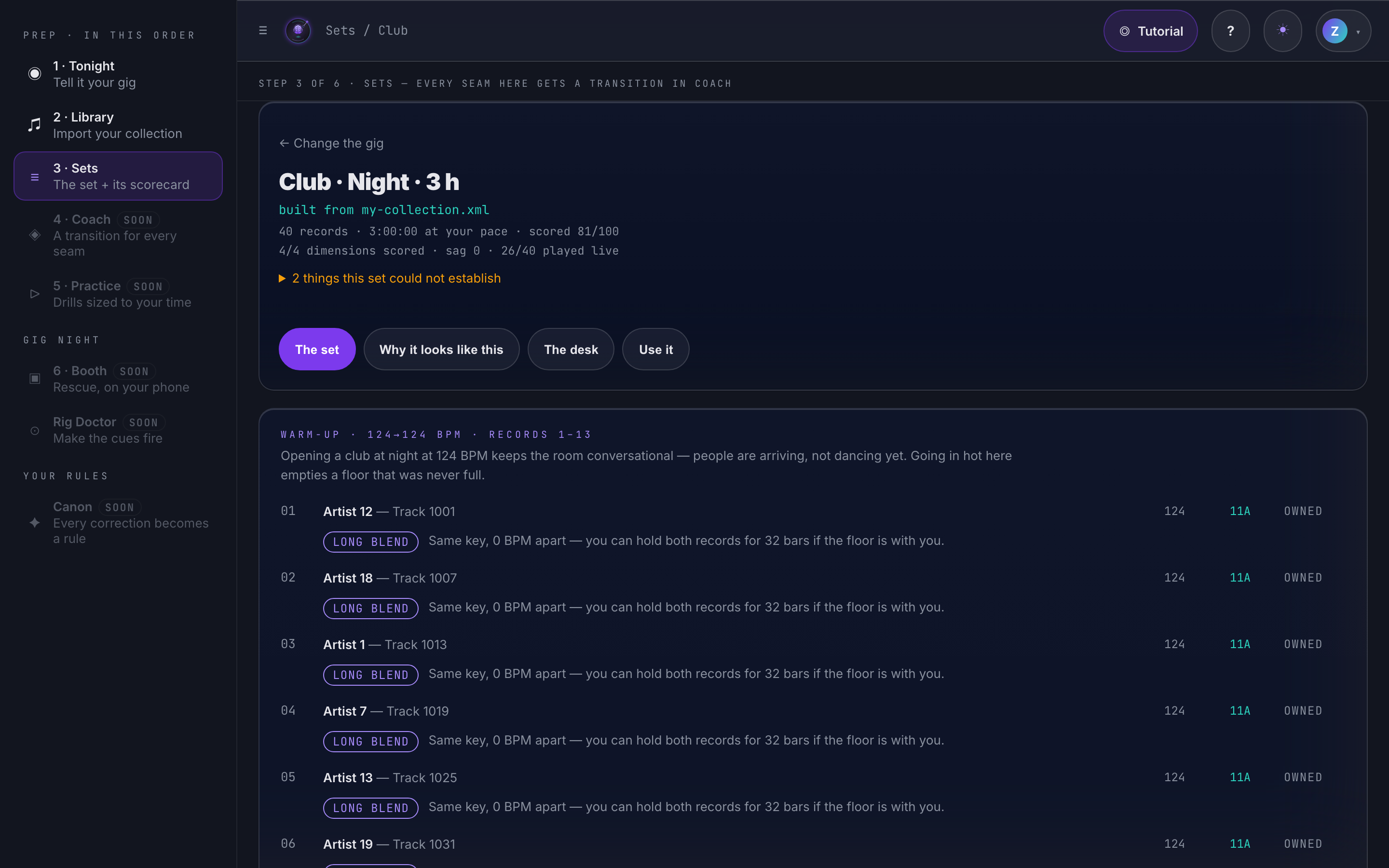
Now playing, time left, the next moment, and one-tap rescue that draws only from tonight’s crate. The Booth is in build — below is Studio running on a phone today, with a set built from a real library. No mockups on this page: every screenshot is the app, signed in, holding real records.
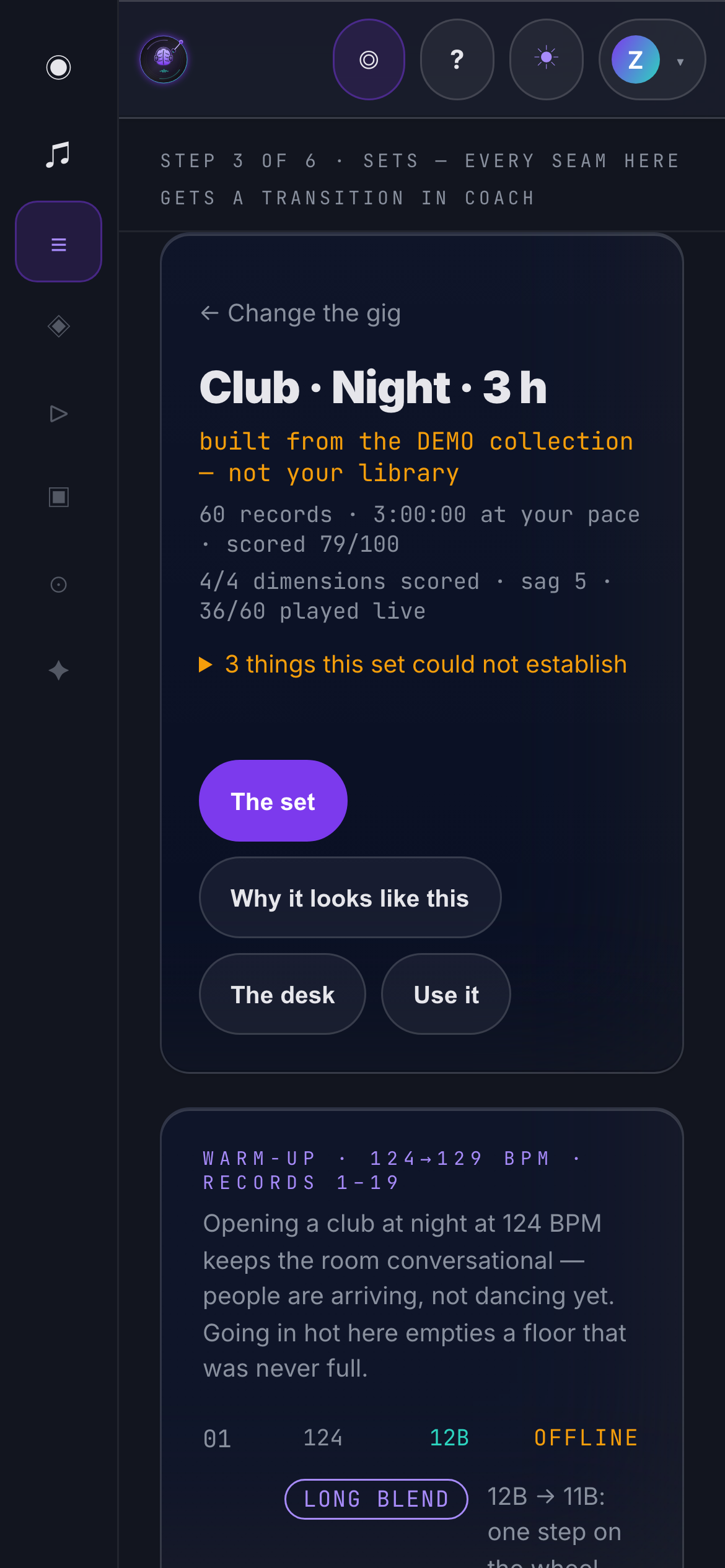
The rescue list is drawn from tonight’s crate only — records you already own and already vetted, so nothing suggests a track you cannot play.
A booth is a basement. Tonight’s set and its rescue crate are on the device, so the thing you need at 1am does not depend on a bar’s wifi.
Nobody reads a dashboard mid-transition. The Booth shows the next decision and nothing else.
Studio. Prep, in the order that works.
A beginner reads the rail top to bottom and knows what to do next — each screen only asks for what the one before it produced.
- Gig
- Library
- Set
- Transitions
- Practice
- Booth
Founding price locks for life.
DJ Brain is in build. Reserve a place now and your price is whatever the founding price turns out to be — set at launch, and it never moves for you.
the standard price moves; yours does not
Whatever it is set to at launch is your price, for as long as you keep the plan.
No card, no trial clock. Reserving costs nothing and commits you to nothing.
The standard price is set after launch. Reserving is what keeps you off it.
- ✓One set at a time
- ✓Library X-ray
- ✓The scorecard
- ✓Read-only Booth
- ✓Unlimited sets and gigs
- ✓Transitions + Practice
- ✓Full Booth with Rescue
- ✓rekordbox export
- ✓Your rules, versioned
- ✓Rescue on your phone
- ✓Listen · 15-second room read
- ✓Offline locker awareness
- ✓Stage View
No card taken while it is in build. Reserving costs nothing and commits you to nothing.
The ones people actually ask.
How do I learn to DJ as a beginner?
Start with one real gig in mind, not a course. Four things in this order: phrasing (count 8s and 32s), the bass swap, key-compatible seams (Camelot ±1), and a set built at your real pace. DJ Brain builds that set from your own library, scores every seam, and sizes the drills to the time you have.
Does it work with rekordbox and a DDJ-FLX4?
That is the rig it was built around. Red triangles are memory cues; the FLX4 pads fire hot cues A–H only, and for a Beatport streaming track the only sequence that works is Store Offline → Import To Collection → auto-analysis → hot cues. Verify in the pad grid, never the waveform letters.
Can I DJ with Beatport streaming and no internet?
Only tracks in the Offline Locker — a hard cap of 1,000. Anything not stored offline is unanalysable and unplayable without wifi, and a lapsed subscription deletes the locker. DJ Brain marks every set OWNED, HYBRID or STREAM and builds a 100%-owned fallback.
Does it touch my rekordbox library?
No. Export writes a NEW playlist and never touches master.db, and a backup is taken before any rekordbox-side change.
How much practice before a gig?
Rehearse the set you will play, not new material — nothing new the night before. 45 focused minutes is enough: five clean reps of your riskiest seam, the warm-up→peak break with its bail version, the budgeted echo outs, and a pad check on three streaming tracks.